

How a 10-minute brain dump became a 1,254-word local story
I went to SCHEELS on opening day with my son, dumped my notes into larkfeed, and got back a finished, designed article. Here's exactly how it works.
 TJ LarkinBuilds larkfeed at 8th replayOctober 1, 2026 · 3 min read


- My son and I went to the new SCHEELS in Cedar Park on opening day, August 29.
- I brain dumped my notes and a few phone photos into the larkfeed article writer.
- About 10 minutes of my time and about 10 minutes of AI time later, I had a 1,254-word story with eight sections.
- A second AI edited and scored the draft. Nothing went live until I said yes.
On August 29, my son and I went to the new SCHEELS in Cedar Park on opening day. It's a 300,000-square-foot sporting goods store with a Ferris wheel, an aquarium and a dinosaur inside. It was a great local story. It was also the kind of story that usually never gets written, because nobody has two spare hours to turn a fun Saturday into a polished article.
This one got written. You can read the finished story on WilCo Guide.
What I actually did
I opened the article writer in larkfeed, picked a style, and brain dumped. What we saw, what surprised us, what my son loved, how parking went, how fast the checkout line moved. I added a few photos from my phone. It was messy, the way notes are.
- 01Pick a style
Templates come with larkfeed, and you can make your own.
- 02Brain dump
What you saw, what surprised you, a few photos from your phone. Messy is fine.
- 03Read, edit, publish
Change what you want. Nothing goes live until you say yes.
That's it. That was my part.
What larkfeed did
The writer took my notes and did the slow work:
- Research. It checked the facts I mentioned and filled in the background: the store's size, the company's history, and the bigger development the store is part of.
- A plan before a draft. It laid out the story before writing it, so the finished piece has a real shape instead of a wall of text.
- A designed article. Not just paragraphs. The finished story has a short version up top, a pull quote, a "by the numbers" card, place details with the address and phone number, and a list of sources.
- A second opinion. A second AI edited the draft and scored it. If it hadn't passed, it would have gone back with notes on exactly what to fix.
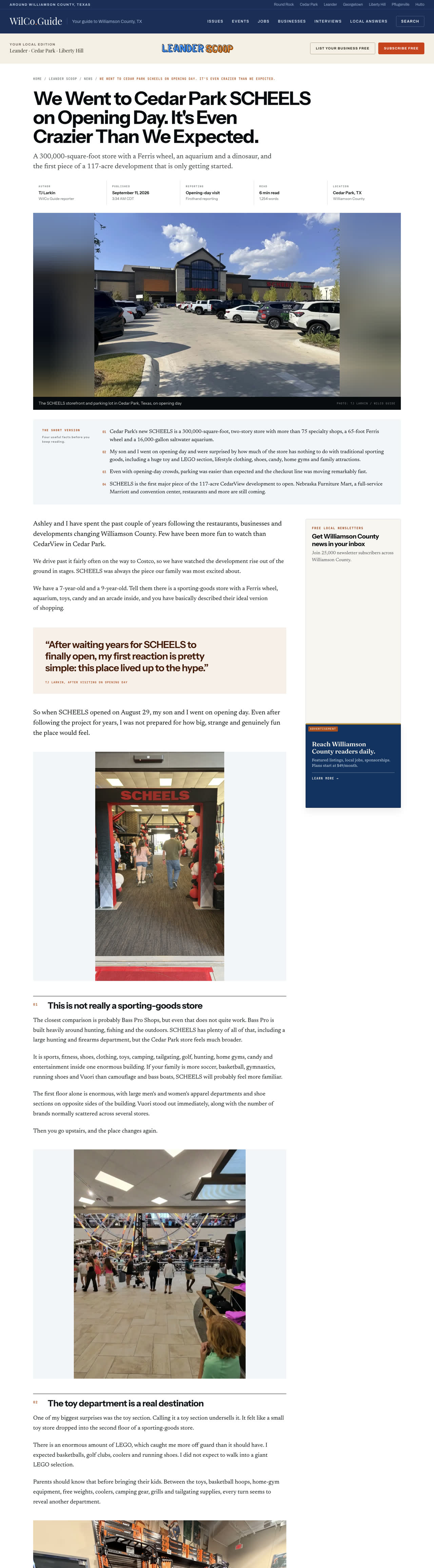
Then it was my turn again. I read it, changed what I wanted, and published. 1,254 words, eight sections, my photos, my voice.

Why this matters for local media
Most local publishers don't have a shortage of stories. They have a shortage of hours. The opening-day visit, the new restaurant, the kid's first season at the rec center. These are the stories readers love most, and they're the first ones cut when time runs out.
When writing a great story takes 10 minutes instead of two hours, you write a lot more of them.
And because every story comes out structured, with sources and place details, it's also the kind of page Google and AI assistants can understand and cite.
What it won't do
It won't make things up. If it can't find a source for something, it leaves it out. And it won't publish on its own. Every article waits for a person.
Try it on your market
Templates come with larkfeed, and you can make your own styles. Book a call and we'll show you the writer on a story from your town.
Questions people ask
How long did the SCHEELS story take?
Does the writer make things up?
Does it publish on its own?
Can I use my own writing styles?
TJ Larkin builds software for local media at 8th replay, the company behind larkfeed, lightbreak and greetform. He and his team run more than 20 local publications on these tools.